The Fourth Precept of Sensei Gichin Funakoshi is

"First know yourself before attempting to know others."

This may sound like a simple plan, but it is deceptive. Many of us believe that we know "who" we are, but in honesty, we wear so many masks, take on so many different roles, and convince ourselves that we are who we are not.

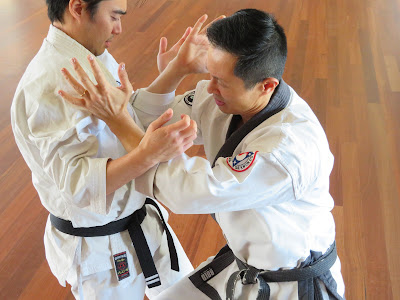
My husband once told me "No one wants to be the bad guy. Everyone wants to wear the white hat." This is so true, and can be seen in the dojo over and over again. We can catch ourselves thinking "If only my partner could have punch properly, I could have blocked that better" or "It's not possible to do this move the way that I'm being asked to do it, my arm doesn't bend that way", or "My instructor is asking too much of me, I'm not capable of doing this"

In each situation we are finding excuses for why we aren't succeeding. We are finding explanations, and arguments in our defense rather than solutions. Being a Martial Artist is taking on responsibility for our own training. We learn to look into ourselves, get to know how to see opportunity, and potential in every moment and action. Are we really as patient as we think we are? Do we look for an easy way out of a challenge, or do we face it head on and conquer it? Are we open to instruction or do we feel that we "know this already"? Can we accept that we might need to try something else, and restructure our perceptions so that we can meet the request of our instructor as best as we can within our limitations?

Our partners are there to do their best, and since they are human, perfection will not be attained. We can learn from these awkward moments, and see them as a potential to cope with the unexpected, and to adapt. Self defense is always a changing situation, and learning about how we personally react to the unexpected, or to inner frustration helps us to find tools to cope in a more stressful moment. Suddenly, we learn about ourselves, and how we can handle these moments better.

Our bodies do not always comply with what our minds want them to do. In fact, when we are tired, or sore, it can be quite a struggle to convince our bodies that this is when we are strengthening, and building muscle/strength/better health. There is a part of us that says "O.K. that's enough.. I can't do any more..." but studies have shown that this is not true. Our muscles normally can do far more than what our head allows them to do. "Researchers from the University of Zurich have now studied in detail what sportsmen and women know from experience: The head plays a key role in tiring endurance performances. They have discovered a mechanism in the brain that triggers a reduction in muscle performance during tiring activities and ensures that one's own physiological limits are not exceeded. " Read more at this site According to this study it is a person's motivation, and will power that will allow them to continue doing more. We have to learn to believe that we are capable of more, and to know ourselves so well that we can see the difference between not far enough, and too far.

Our Instructors are there to challenge us. They see our potential, and ask us to reach for higher than that. Why? because we learn just how far we can go when we stretch beyond what we think we can do. We can never learn that lesson by staying in the safe, comfort zone. Capable, not capable is not the point... WILLING is what is important. Are we willing to step out of where we think it is safe? Do we trust ourselves? Do we know ourselves well enough to believe that there is no such thing as failure when you do your best? Do we allow fear, insecurity, laziness, pride, etc to stop us from growing? Most of us would not want to honestly admit that this might be what is happening. We'd rather blame our environment, and the people around us. This defense mechanism works, but it will never allow you to know yourself.


--
Colin Wee
Joong Do Kwan Chung Sah Nim
[Traditional Taekwondo Blog | Subscribe | FAQs | Sitemap | FaceBook]

And help us rank on Google by clicking the '+1' icon, why don't you?

Links to this post
My Super Power - ability to destress through weekly training!

There are way too many instructors, schools, and clubs in this industry who brag about how good they are, oftentimes with very little to back them up. How many times have I heard: "Our style is the best." "Our black belt gradings are so tough." "Our syllabus is so complete." "Our instructor is so awesome." Yawn.

Several years ago, against this grain, a very accomplished martial artist friend of mine posted that he has even more of a reason not to say he is any good - he simply said he is now dedicated to pursuing and preserving a Koryu tradition. Tongue-in-cheek but solid wisdom from a humble master. Someone I could never beat in the sparring ring.

So ... what would you gain from joining our school?

My aims are simple. To share a small range of hard style techniques from an interesting period in history. Our story is compelling, you should listen to it if you have time. But the reality is that hard styles like ours are a 'meat and potatoes' system. Simple. Unfussed. Otherwise boring to those who would pepper their sentences with terms like MMA, BJJ, CQC, etc.

Our 'program' to black belt whilst challenging should be doable by almost everyone, and can be completed in about 4+ years if you train moderately and consistently. No special physical talent is needed though good coordination is always a plus from the instruction point of view. Come to Joong Do Kwan and gain some good all round skills - some defence capability, some technique delivery, some multiple person tactics, and sparring experience. Just so you know, sparring is not full contact - it's semi contact.

It's the even progress that I think is more important than super dooper sparring skills or having an extensive but superficial collection of techniques. This ability to deal with some conflict scenarios plus the ability to 'power up' a few basic techniques may give you an edge in a confrontation. Come to think of it, just our overall approach increases your preparedness - not just for physical conflict, but mental and emotional ones too. From what I've seen, there's also a major upshot to regular training - the sessions help you to destress from the day, and generally allow you to manage life better on a day-to-day basis.

Now ... what is it that I wanted to brag about?

Colin
--
Colin Wee
Joong Do Kwan Chung Sah Nim
[Traditional Taekwondo Blog | Subscribe | FAQs | Sitemap | FaceBook]
And help us rank on Google by clicking the '+1' icon, why don't you?
Links to this post

Nice belt, Dude.

  • A beginner feels anxiety going for a grading to win his next rank.
  • A senior student feels like he needs to put the brakes on because he's 'ranking' too fast. 
  • A shodan feels unworthy of his rank. 
  • A black belt young in the arts feel the weight of expectations to get his next rank. 
  • Qualifying instructors compare the 'quality' of their rank against their peers and others in the arts. 
  • Teachers suddenly become aware that they're climbing the rank structure and start to look around for peer support from people who might understand their stage of development
  • There is huge dissonance between your expectations of rank and titles you might start to receive. This gets more acute when you receive titles that are 'honorary.' Are you really worthy? Or are these awards actually worthwhile?

In my opinion, there are many martial artists out there that have a set view of rank. Many understand rank only through the lens of a beginning practitioner. Rank is something to struggle with for a number of months, and then there is the need to 'work on' the next rank. The world is simple, uncomplicated, and directed; it is a world where rank is associated with incremental physical challenges.

Pretty soon, the notions of rank and the idea of how it works collides with other expectations and assumptions, and the world becomes less simple. The most major event that arrives is the stereotype of a black belt that everyone has. Yet people in the know understand that a first dan or shodan has really only started the journey. Truthfully, I knew jack when I got my first black belt. Not to belabour a point, the  shodan needs to leap over this mountain of expectations built up within himself. It is far from the small incremental challenges previously faced.

I think the internet has been both a boon and bane to rank, the value of your own effort, the quality of your skill, credibility of your lineage, and the validity of your claims. Everyone makes comparisons and seeks to benchmark themselves. But in a world in which there is no standard, you will eventually find yourself on a slippery slope trying to ascertain who is making more progress. But the internet will not tell you who is traveling upwards or downwards on that slope. Eventually you will only see what you were expecting to see.

This was never how rank was supposed to work. It was supposed to be a simple method to structure a 'coloured belt' class, and motivate people to work harder. All black belts were given deferential treatment and duly respected, both for their unrelenting focus on progress and then on their deepening skills and knowledge. No need to jostle for a bounty of rank or title, but if it came, they would graciously accept and take it in their stride. The fuss does not detract from quality or purpose. And the world becomes once again simple and clear.

Links


--
Colin Wee
Joong Do Kwan Chung Sah Nim
[Traditional Taekwondo Blog | Subscribe | FAQs | Sitemap | FaceBook]
And help us rank on Google by clicking the '+1' icon, why don't you?
Links to this post
One step sparring is the 'defacto' application of techniques found in patterns and drills of most hard style Taekwondo or Karate schools. For one steps, you have two practitioners facing off, the opponent or 'attacker' steps back into a down block, lunges forward in a forward lunge punch and leaves his striking arm in place. The defender's task is to respond to this attack by using some manner of block and strike, and an appropriate sidestep. You could get very inventive and in fact most Taekwondo schools not only do one steps, they expand this exercise to include three step sparring for good measure.


The one step sparring exercise is the most contrived of all drills.

Using it to practice a wide variety of techniques is one way to achieve diminishing returns from your 'traditional' type practice. In my opinion, the one step is partly an exercise in learning distancing and timing. But the main goal is in the application of basic blocks as effective self defence tools for all students - that specifically means beginners.

In the video you see an application of a lower block to the inside of a strike. The previous week we looked at a lower block done on the outside of the strike. In this week's lesson, the reverse or pull back hand deflects the main strike and the block destroys the striking arm. In actuality if both hands come together quickly as an entire blocking tool, the blocking hand can still block the oncoming strike, and then be used against opponent's body.

Beyond this particular segment of the class, we did the unthinkable - we fold for the lower block, but recognise that the opponent is moving too fast - and from having the right blocking arm next to the left ear, we perform a middle block to the opponent's secondary weapon. It is forcing yourself to use the opening and closing of the arms as an effective windshield wiper to strikes coming one at a time or too fast.

Right at the end you see me deflect the strike with my pull back hand, but perform an eye strike with the blocking hand - before destroying the oncoming strike. This was not rehearsed! But because we perform basic blocks all day every day, we can ad lib like this very easily and still access the basic movements in a self defence situation.

The Problem with Hard Style Systems like Karate and Taekwondo
Taekwondo Pattern Chon-ji Hyung List of Posts
Chon-ji Down Block Drills

Also see Why Taekwondo is Not Good for Self Defence by Soo Shim Kwan
--
Colin Wee
Chung Sah Nim (Principal)
[Traditional Taekwondo Blog | Subscribe | FAQs | Sitemap | FaceBook]
And help us rank on Google by clicking the '+1' icon, why don't you?
Links to this post
The basic Taekwondo kick is a misnomer. It is an undervalued short range powerful technique. Let's talk about the basic kick in terms of the front kick and the roundhouse kick.

A front kick is done on a vertical lane where the roundhouse kick is done on a horizontal plane. It is a short range kick and thus 'compresses' the body, generating power because the upper body and the lower body come closer together. The roundhouse kick does the same but rotated 90 degrees.

The long range version of these kicks seem to be valued more because they are techniques done to keep an opponent at bay - essential for beginners dealing with the pressure of a dynamic opponent. Long range techniques require expansion of the body - meaning both the upper body and lower body travel further away from each other in contrast to short range kicks. In this case, both the long range and roundhouse kicks generate power in a pendulum swing - using the upper body as a counter weight and the hip as a fulcrum.

The vertical and horizontal plane are explored in order to establish the outer parameters for these two kicks. Each slice between zero and ninety degrees are legitimate kicks. If you talk about short range and long range techniques too, the articulation of the hip also allows for a 90 degree variance in angle of entry.

Two exercises that allow a practitioner to more fully explore this are 1) exercises to challenge the practitioner to land the technique and 2) exercises the challenge the practitioner to be aware of the flight path of the technique.

Landing the technique through obstacles and weaseling the foot through three dimensional space forces the practitioner to rotate the hip on the vertical and horizontal and extend it sufficiently for it to land on small targets on the opponent's body. Understanding the flight path of a kick allows you to take advantage of blind spots from the opponent's point of view (e.g. under arms, behind shoulders, or under outstretched legs.)

I urge all practitioners not to devalue the short range kick - it is a devastating part of your arsenal and has to be the cornerstone on which all kicks are based. 

Colin


Links
--
Colin Wee
Chung Sah Nim (Principal)
[Traditional Taekwondo Blog | Subscribe | FAQs | Sitemap | FaceBook]
And help us rank on Google by clicking the '+1' icon, why don't you?
Links to this post
A couple of senior belts and I met to go over requirements and specifically trained in Hwa-rang on the lawn at College Park today.

I wasn't dressed like anything resembling the flower warrior youth group- with a baseball cap and my 'competition' gi from century ma. But we sure looked at techniques that were hard hitting indeed.

The few that I'd like to mention quickly are - a counter against a front lunging technique using a deflect then choke associated with a cross body punch; an attack to the neck as a counter against a lapel grab; a response against a punch and cross using the double blocks to parry and attack; and a ruthless joint attack or arm destruction off steps 4-6.

The Hwa-rang were known for their kicks, or their reputation was built off formidable kicking techniques. We looked at the low x block, crescent kick, and the low block/elbow strike as a response against a lunge strike. The x block is a deflect and arm capture - the crescent kick is an attack to either the hand (if the opponent is carrying a long range weapon) or if not, is aimed at the elbow or bicep. Once done, the practitioner can access Toi-gye level apps and when bringing down the leg - could expand the body and send the leg strike into the oppnent's knee or thigh on the way down.

Surely, something a Hwa-rang would appreciate.

Links


--
Colin Wee
Chung Sah Nim (Principal)
[Traditional Taekwondo Blog | Subscribe | FAQs | Sitemap | FaceBook]
And help us rank on Google by clicking the '+1' icon, why don't you?
Links to this post
One of the few things I wanted to accomplish for the Joong Do Kwan was to introduce a sparring 'program' in which students, especially beginners, would learn sparring skills and would steadily improve in their abilities. Last week, we had a few friends visit our kwan, and we took the opportunity to look at the beginner to intermediate stages of our program.

The main problem when it comes to sparring? Sparring should only be part of your entire bag of exercises. Everyone however equates great sparring skills with great martial art ability - and this is a mindset that many instructors try to dispel.

Basic Skills Start Way Before You Spar
Lots of good sparring skills can be introduced way before opponents go head to head. During warmups, students can be prompted to raise their hands above their jawline, and to tuck their chins down into their shoulders. If you get your students to do side skips you can also make sure they're moving on the balls of their feet rather than on their heels. See Warmup Drills to Increase Coverage for Sparring

Non-Contact Drills
We have this multiple person non contact sparring drill where we get one person against two opponents. The 'defender' in the middle has to try and align both of his opponents and use one of them as a shield. After some time he drops the shield and goes to the other person. The rules of the game doesn't allow opponents to grab, so this allows the 'game' to proceed fairly fluidly. This exercise helps students increase awareness, increases cardiovascular fitness, and helps introduce some really good tactics to use in a multiple person scenario. See Taekwondo Non-contact Sparring Training, Multiple Person Drills

Moving Around
Beginners start their sparring training just moving around each other in a circular fashion. They back themselves into a circumference of the circle around each other. Every four seconds they are told to switch and change direction. Hands are held up defensively, breath is managed, and footwork needs to be light.

Calibrating Power
Beginners not only land kicks or strikes on to kick shields and striking mitts - they MUST land and practice strikes on an opponent's body. This is the way in which they are taught to moderate their strikes and control how hard to launch a kick and how to appropriately target an opponent's body. Their opponent should accept strikes comfortably and should communicate whether they need to be struck harder or softer.

Basic Coverage
I think that going up and down the line doing kicks and blocks is great to make sure everyone is getting basic movements correct. But trying to resolve 'the block' as a technique and the speed at which an opponent comes at you is very difficult. So what we do is to repeatedly fold for blocks, swinging the arms together and using that fold as a basic skill for providing coverage.We then use this move - bringing the elbows together against strikes and covering the body to ensure that there is enough speed to deal with an attack. Beginners are paired up with intermediate or above students. They are instructed to only block, and opponents are told to attack with large looping techniques that are easily seen. Students need to continue Moving Around properly. 

Basic Coverage is tested using attacks that are less telegraphed. Once the student can continue Moving Around smoothly, breathing naturally, and able to recognise attacks, it is time to up the ante.

Distancing and Attacking
Beginners are now allowed to use one or two techniques (typically a lunge punch and a front kick) to attack their opponent. The opponent should be an intermediate belt and above and is told to cover and block only. Beginners learn to move around, target, and place strikes on opponent's body in a dynamic environment.

Applying New Techniques
The beginner and intermediate practitioner has a lot to learn and needs to improve the speed at which he is processing things around himself. One tool in which can be used to help the beginner is the use of the 'Sparring Bingo' game. The student is presented with 9 techniques and whilst sparring needs to cross out techniques used. This lightens the mental burden the student has, and yet allows them to try different techniques against an non-compliant opponent.

Links
--
Colin Wee
Chung Sah Nim (Principal)
[Traditional Taekwondo Blog | Subscribe | FAQs | Sitemap | FaceBook]
Links to this post


GM Choi Hong Hi was requested in 1952 to train the entire army in the martial arts. In 1955, 'Taekwondo' was accepted as the name to unify the kwans in Korea.
--
Colin Wee
Chung Sah Nim (Principal), Joong Do Kwan Tae Kwon Do
School of the Middle Way - the point between old Okinawan predecessors and modern Korean innovations. Started as HRGB April 2000, reborn as JDK Sept 2011.
Traditional Taekwondo Techniques, Patterns, and Applications at the Traditional Taekwondo Blog. [Subscribe using email or RSS feeds] [Tkd Sitemap]. Colin is a martial art instructor with 28 years of experience across three continents. Colin leads a small Traditional Taekwondo group for adults in Perth, Western Australia. Connect with Colin on Traditional Taekwondo FB page. And help us rank on Google by clicking the '+1' icon, why don't you?
Have you checked out the Shop we've just set up?
Links to this post

Get a Copy of Our Syllabus and Student Handbook

Get the same document and understand the training program we use at our school! With 60 over pages, this syllabus will bring you through white to black belt requirements. The 40+ page student manual covers everything from rank requirements to how to behave within the martial arts school environment.
Books plus Shipping Method